
Newsletter operator
Newsletter Issue → LinkedIn Carousel
One paid Chinese newsletter issue on cross-border payments, rebuilt as a 7-slide LinkedIn carousel that reaches the readers who never subscribe.
Illustrative example: the scenario and figures below are for illustration only, not a client result and not a performance claim.
Before → After
Before
A Chinese draft nobody outside China can read
- Language
- Chinese
- Audience
- Domestic readers only
After
A publishable English asset
- Language
- English
- Audience
- English-speaking buyers and builders
- Output
- 7 slides
01What went in
开香港主体加美元账户并不能解决跨境收款,它只是把问题从「怎么收到钱」换成了「账户为什么被冻」。
这一期只论证一件事:开香港主体加美元账户,并不能解决跨境收款。 支撑材料:
- 三条收款路径对比:香港主体 + 美元账户、内地主体 + 跨境人民币结算、美国主体 + Stripe Atlas。
- 每收 1 万美元的全成本:香港主体 3.1%(汇差 1.8% + 银行手续费 0.6% + 合规 0.7%);跨境人民币 2.2%,但有额度且慢;美国主体 2.9%,另加每年 800–2,000 美元的维护成本。
- 到账时间:香港 2–5 个工作日,人民币 5–15 天,美国 2 天。
- 没人计价的失败模式:作者有两位客户的香港账户在 KYC 复核期间被冻结 11 周,钱在里面。
- 真正的建议:按付款方在哪里选主体,而不是按创始人想在哪里落地。
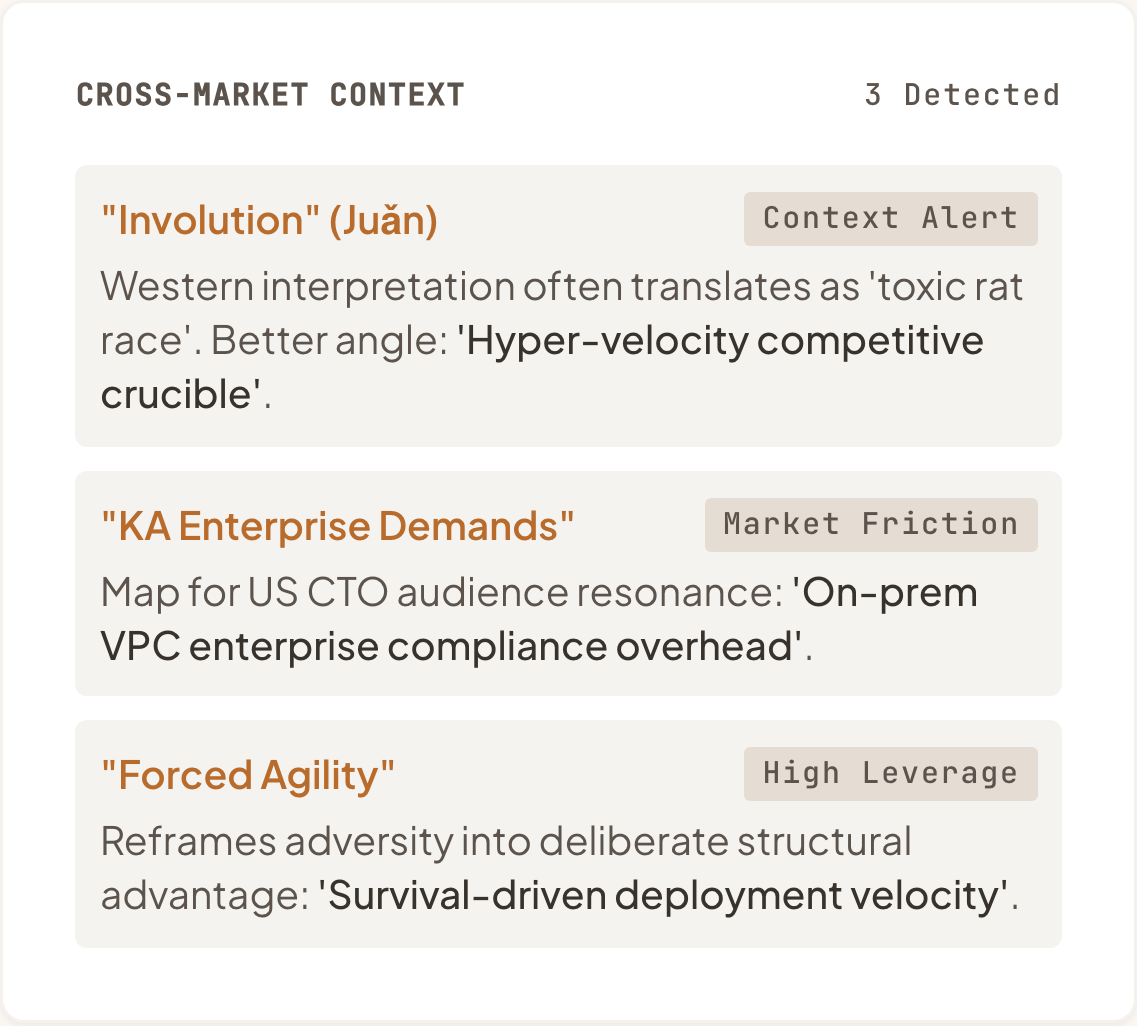
02Five angles out of one article
"A Hong Kong entity does not fix cross-border payments. It moves the problem from 'how do I get paid' to 'why is my account frozen.'"
- It attacks a piece of advice that is repeated constantly in founder communities.
- It introduces a cost nobody quotes: frozen capital.
- It offers a decision rule, not a vendor list.
03What came out
Slide 1 — Hook
A Hong Kong entity does not fix cross-border payments.
It changes which problem you have.
Slide 2 — The advice everyone repeats
"Set up an HK entity. Open a USD account. Done."
This is true for invoicing.
It is not true for collecting at volume.
Slide 3 — The costs people compare
Per $10,000 collected:
- HK entity + USD account: 3.1%
- Cross-border RMB settlement: 2.2%
- US entity + Stripe: 2.9% + upkeep
On a spreadsheet, RMB wins.
Slide 4 — The cost nobody puts on the spreadsheet
Two clients. HK accounts frozen during KYC review.
Eleven weeks each. With revenue inside.
A 0.9% fee difference is nothing against eleven weeks of working capital.
Slide 5 — What actually determines the answer
Not your domicile preference.
Where your payer is:
- US payers, US card: US entity
- EU payers, bank transfer: HK or EM I
- Domestic revenue, export contract: cross-border RMB
Slide 6 — The decision rule
Write down your top three payers and their payment method.
Pick the entity that matches those, not the one your accountant prefers.
If the top three disagree, you need two entities — and you should know that before you sign anything.
Slide 7 — Close
Cross-border payments is not a banking problem.
It is a "who is actually sending me money" problem.
Full breakdown in the comments.
Reuse the same moves
-
01
Pick the issue with a number in itOpinion issues do not travel. Issues with a cost, a duration, or a rate do.
-
02
Find the advice your issue contradictsEvery strong issue argues against something. That contradiction is slide 1.
-
03
Put the comparison in one slideThree options, three costs. Do not spread it across three slides.
-
04
Add the hidden costThe thing your readers email you about is the thing your carousel should lead with.
-
05
End with a rule, not a summary"Match the entity to the payer" is portable. "It depends" is not.
-
06
Link the original issueThe carousel is the funnel, not the destination.
Keep reading
- Use case How to Turn Newsletters into Social Media Posts Split one newsletter issue into platform-native posts without flattening the argument that made the issue worth reading in the first place.
- Article Why 90% of indie hackers die in three months Most micro-SaaS products fail on two invisible traps and a mistaken idea of distribution, not on bad code.